Tenganan Village Bali | History, Traditions & Complete Visitor Guide
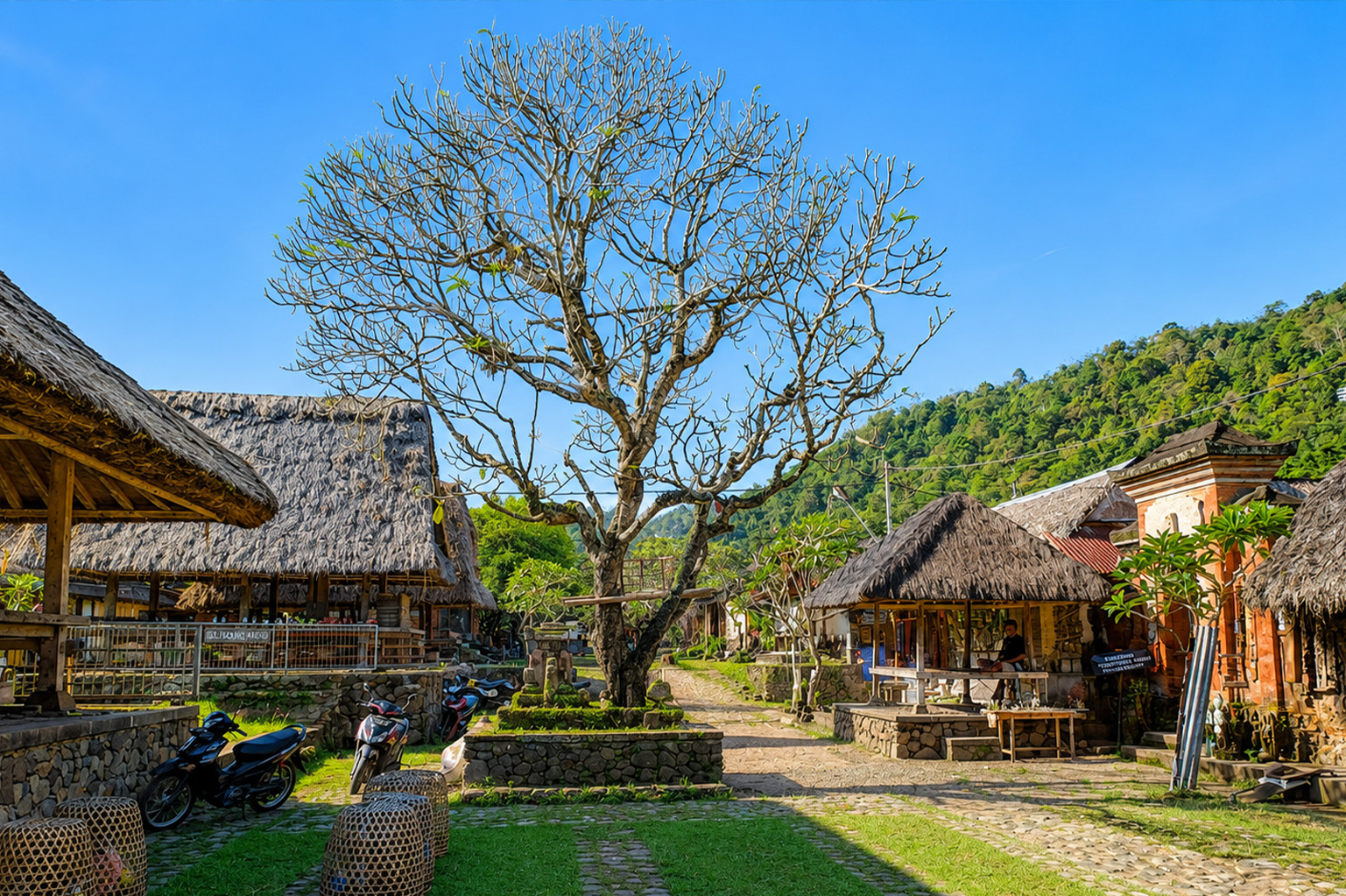
Tenganan Village stone-paved centre in Karangasem, East Bali
Tenganan Village is one of Bali’s oldest traditional villages. Located in Karangasem, East Bali, this settlement preserves ancient traditions. Here, the Bali Aga people continue to keep centuries-old customs alive. Sacred rituals remain an important part of daily life. Traditional homes are still built using ancestral methods. And The famous Geringsing cloth continues to be woven by local artisans. Much of this tradition began before the Majapahit Kingdom ever reached Bali.
Ask a Balinese guide to name the island’s oldest village, and Tenganan is often the first answer. Other Bali Aga villages share equally old roots. But Tenganan stands apart. Its old laws still hold. Its layout has barely changed. And its traditions still shape daily life today.
So if you love Balinese history and real local culture, Tenganan offers a rich journey into Bali’s living heritage.
The Ancient History of Tenganan Village
Tenganan’s story starts with its people. They belong to the Bali Aga, which means “original Balinese.” These groups trace their roots to before the Majapahit Kingdom arrived from Java in the 14th century. That Hindu-Javanese wave reshaped mainstream Balinese religion, art, and daily life. But a few villages, including Tenganan, stayed largely outside its reach. As a result, they kept an older layer of Balinese belief. This layer blends respect for the god Indra with animist practice and ancestor worship. Few other places on the island kept these old beliefs in their original form.
This point matters more than any single founding date. Many places in Bali are simply old; they have existed a long time. Tenganan, however, is old in a different way. It stayed culturally apart from the mainstream growth of Balinese Hinduism. And that is a far rarer thing to keep.
Three Founding Stories
Tenganan tells its own founding story in more than one way. Local sources do not always agree on the details. If anything, that disagreement points to something important. This history is old enough that people passed it down long before anyone wrote a single, standard version.
The most common version centers on a sacred white horse named Onceswara, also called Uccaisrawa. The god Indra had just defeated a cruel king named Mayadenawa. This king had banned a nearby village from worshipping at Besakih, Bali’s most important temple. As part of the victory celebration, villagers planned to sacrifice the horse. But the horse vanished first. Search parties later found it dead. So Indra rewarded the village’s loyalty with land. Villagers scattered the horse’s remains across the valley to claim as much territory as they could.
A second account traces Tenganan’s founders to Peneges, a settlement near Bedahulu in today’s Gianyar Regency. These people moved east and settled between three hills.
A third, more literal version points to an old Balinese inscription. It bears the word “Tranganan.” Some local historians read this as an early written mention of the village’s name.
Most local accounts place the origins of Tenganan Village in the 11th century. This was centuries before Majapahit influence reached Bali. Because of this, the village was able to preserve its unique traditions and customs.
From Legend to a Village Name
However people tell the story, it always ends the same way. Three hills ring the village: Bukit Kangin to the east, Bukit Kauh to the west, Bukit Kaja to the north. Locals called it Ngetengahang, meaning “to move to the middle.” Over time, this name shortened to Tenganan.
The Sacred Stones
Several old stones around the village still hold deep meaning today. Locals see them as real remains of the founding myth. Each one ties to a different part of the horse, and to a different ritual purpose. It is a rare case where a legend left behind real objects that people still visit and honor:
- Kakidukun – In the village’s north. It is shaped like a phallus, and couples hoping to conceive make offerings here.
- Batu Taikik – The largest stone in the area. Locals link it to prosperity rites and shared ceremonies.
- Penimbalan – In the west. This stone connects to the Teruna Nyoman rite, which marks a young man’s coming of age.
- Batu Jaran – This marks the spot where, legend says, the sacred horse died. Locals still keep it as a memorial to the village’s origin.
Tenganan Village Layout and Traditional Architecture
A founding legend only explains so much, though. What has actually kept Tenganan this old is far less mystical. It comes down to a physical layout and a legal code. Both have stayed remarkably stable.
Six Rows, One Plan
Six parallel rows of stone-paved lanes run north to south through the village. Near-identical thatched-roof homes line each row. Community halls and temples sit at the centre. The whole layout follows Tri Hita Karana, the Balinese idea of harmony between people, nature, and the divine. In practice, it also shows a level of shared planning that has held for centuries. Cars have never been part of that plan. Visitors still park at the entrance and walk in, much as anyone would have a few centuries ago.
A small river splits the wider area in two. The eastern side, Tenganan Pegringsingan, is the village most visitors see. The western side, Tenganan Dauh Tukad, is a related but separate community. Locals organise the village into three banjar, or neighbourhood groups: Banjar Kauh, Banjar Tengah, and Banjar Pande.
Inside a Family Compound
Each family compound follows the Sanga Mandala system, a form of spatial order. Every compound includes four core buildings. Near the entrance, close to the sacred main road, sits the Bale Uga, also called Bale Buga, a ritual hall. The Bale Tengah sits at the centre and splits into two rooms: one for death rites, the other for welcoming newborns. Families use the Bale Meten as a flexible space, often as a bedroom or living area. And the Paon, the kitchen, sits to the south, with a bathroom attached.
Builders made entrances narrow on purpose, wide enough for only one person. Courtyard doors face south, following traditional spatial rules.
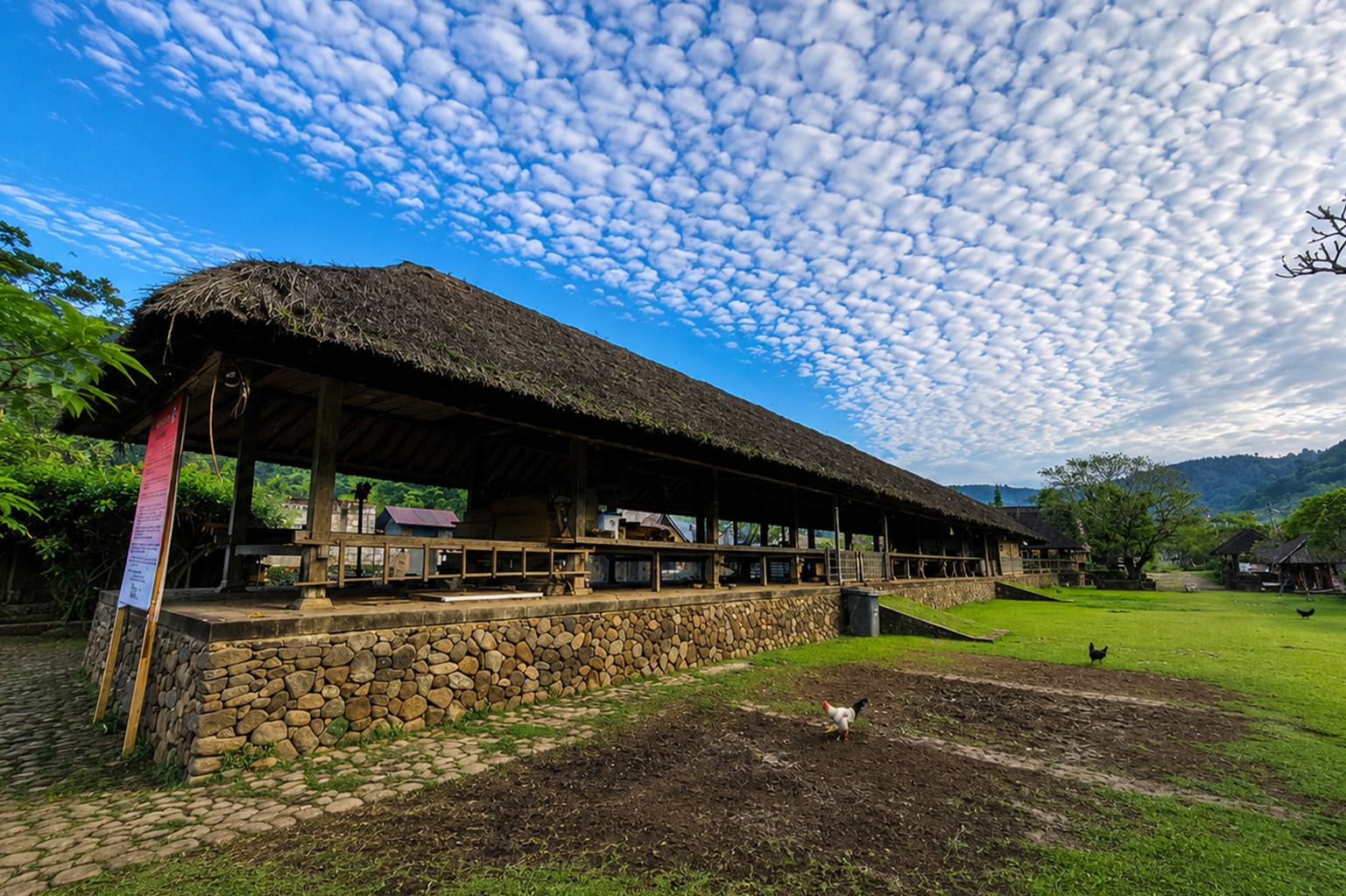
Communal pavilion in Tenganan Village’s centuries-old layout
Bali Aga Identity in Tenganan Village
The village layout gives Tenganan its physical staying power. But awig-awig gives it legal staying power. This is the village’s customary code. It stayed unwritten for generations before villagers finally wrote it down. It governs land rights, inheritance, ritual duties, and, most famously, marriage. Villagers traditionally marry within Tenganan. Anyone who marries outside the community loses the right to live there.
It is a demanding system. But this strict rule, not nostalgia, has kept the community’s bloodlines, customs, and layout very stable over time. That is a big part of why Tenganan’s claim to being Bali’s oldest village holds up so well.
Traditions That Have Outlasted Empires
Mekare-Kare: The Pandan War
Perhaps the clearest sign of Tenganan’s age is what its residents still do every year. Mekare-Kare, also called Perang Pandan, is a ceremonial duel. Young men strike each other with bundles of thorny pandan leaves. At the same time, they defend themselves with woven rattan shields. The duel forms the high point of Usaba Sambah, a yearly cycle that villagers usually hold in June or July. Locals see it as an offering of respect to Bhatara Indra, not an act of violence.
Afterward, villagers treat pandan-thorn wounds with a traditional paste made from grated turmeric, galangal, and coconut oil. For young men, the ritual works as a rite of passage. Meanwhile, unmarried girls take part in a separate ceremony during the same festival period. They ride the Ayunan Jantra, a large wooden swing, while two attendants set it in motion. This ritual stands for the ongoing cycle of life.
Gamelan Selonding
Tenganan is also one of a small handful of villages that still keeps gamelan selonding alive. This rare, sacred orchestra uses forged iron instead of the bronze most Balinese gamelan groups use. Many call it one of the island’s oldest musical traditions. You will rarely hear it outside ceremonial settings. Some accounts even treat the instruments themselves as sacred, not just tools for making music.
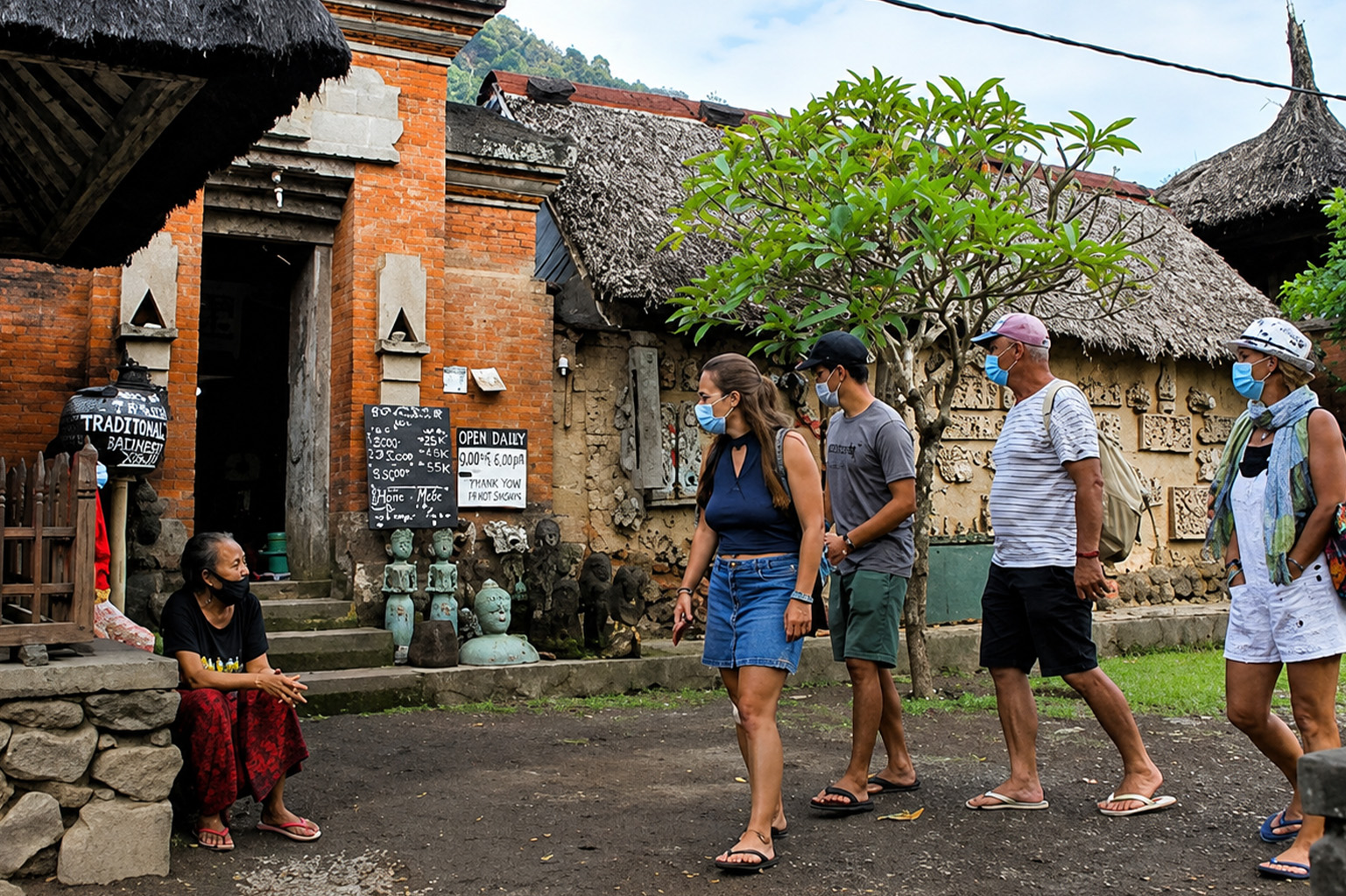
Visitors exploring Tenganan Village traditional compounds and craft stalls
Traditional Crafts in Tenganan Village
Geringsing: The Double Ikat Cloth
Tenganan’s defining craft is geringsing, a hand-woven textile. Locals often explain the name as a mix of gering, meaning sickness, and sing, meaning no. In other words, this is cloth that wards off illness and bad luck. Weavers make it using the double ikat method. First, they tie and dye both the vertical and horizontal threads. Only then does the weaving begin. Just two or three other places in the world still practise this method.
Weavers use candlenut oil to fix natural dyes. The colours build up over many cycles. A single piece may take months, or even years, depending on the complexity of its pattern.
Geringsing plays a role at nearly every major life stage in Bali Aga society. Families use it for infant hair-cutting ceremonies, teenage tooth-filing rites, weddings, and finally as a shroud in cremation rites. Many patterns include star shapes that stand for the divine realm of Indra. Local belief credits Indra with teaching the technique to the village’s women in the first place.
The cloth’s fame has also reached well beyond the village. In 2022, organisers gave pieces of geringsing as an official gift at the G20 Summit in Bali.
Prasi: Lontar Leaf Manuscripts
Alongside weaving, Tenganan is known for prasi. This art carves pictures and script onto dried lontar, or palm, leaves. Artisans use a fine tool for this work. They call it a pengrupak. Lontar manuscripts were once Bali’s main form of book-making. They recorded everything from religious texts to folk stories. Today, the craft survives in Tenganan as both an art form and a direct link to the island’s early literary past.
Rattan, Bamboo and Black Honey
Small household workshops around the village make woven rattan and bamboo baskets. Often, the same family both makes and sells each piece. You can watch the weaving process if you stop by. Several households also keep native Trigona bees, a stingless species. They sell the dark, unique-tasting honey directly to visitors.
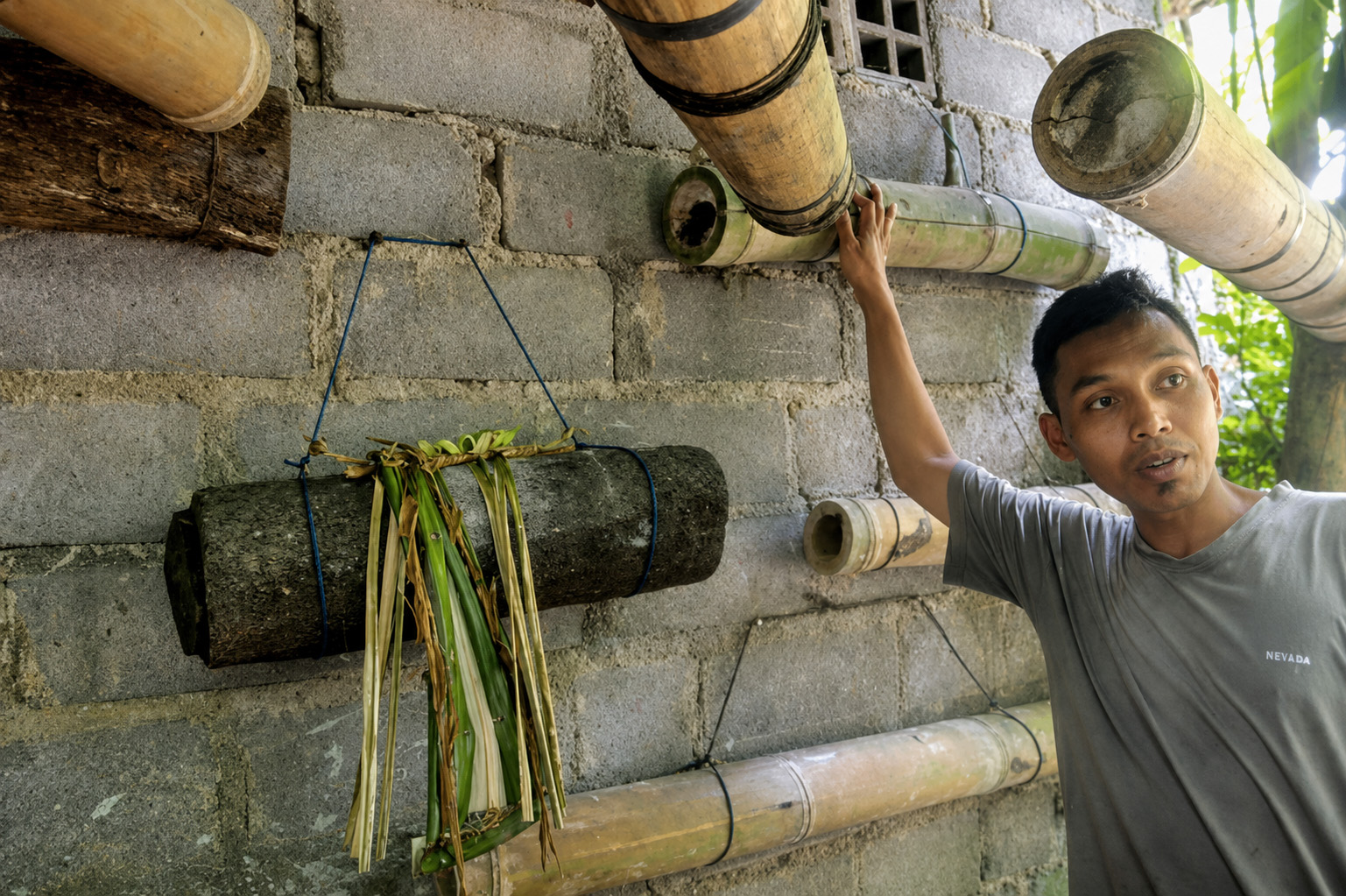
Trigona bee farm and rattan craft workshop in Tenganan Village
Is Tenganan Really the Oldest? A Fair Caveat
In the interest of accuracy: Tenganan is not the only Bali Aga village that claims deep age. Trunyan, on the shore of Lake Batur, is equally old by most accounts. It keeps its own unbroken traditions, including an unusual above-ground burial custom. Villages like Sembiran, Julah, Pedawa, and Tigawasa in the northern highlands make similar claims.
No study has ever proven which of these villages is truly “oldest.” Written records from this period in Bali’s history are thin. Much of what we know rests on oral tradition, temple inscriptions, and customary law, rather than solid dated proof.
What sets Tenganan apart is not a stronger date. It is a stronger combination. Its customary law has visibly held, and villagers still enforce the marriage rule. Nobody has redrawn its village plan. And its textile tradition survives almost nowhere else on Earth. All three still work together, in one place.
That combination explains why travel writers, historians, and Balinese cultural sources keep naming Tenganan first. Strictly speaking, though, it shares that title with a small circle of equally old neighbours.
Tenganan Among Bali’s Traditional Villages
Tenganan is one of roughly eight known Bali Aga settlements on the island. The others include Trunyan, Sembiran, Julah, Pedawa, Tigawasa, Cempaga, and Sidatapa. Among the villages that travellers most often visit, three names tend to come up together:
- Penglipuran (Bangli) – People praise it for its spotless, uniform architecture. Many call it one of the world’s cleanest villages. It is polished and easy to visit.
- Trunyan (Kintamani) – You can only reach it by boat across Lake Batur. Its rare above-ground burial custom, beneath a sacred tree, draws visitors.
- Tenganan Pegringsingan (Karangasem) – This is arguably the deepest cultural dive of the three. Its intact customary law, sacred gamelan, and rare double-ikat weaving set it apart.
Penglipuran rewards visitors chasing tidy, photogenic streets. Tenganan, meanwhile, rewards those willing to slow down and ask questions. That is exactly why it tends to anchor culture-focused East Bali trip plans.
Planning Your Visit to Tenganan Village
Tenganan sits in Manggis District, Karangasem Regency. It is roughly 5 km inland from Candidasa, and about 65 km east of Denpasar. That is a drive of around 2 to 2.5 hours from south Bali’s tourist areas. Ride-hailing apps and taxis rarely reach the village directly. So most visitors arrive with a private driver, or as part of an organised tour. A driver also makes it easy to combine Tenganan with nearby sights on the same day. Popular add-ons include Tirta Gangga, Taman Ujung, and Candidasa Beach. Visitors leave their vehicles at the entrance, since the village itself stays closed to traffic.
| Item | Cost |
| Village entry (voluntary donation) | Free – typically IDR 30,000–100,000 per person |
| Guided village tour (guide + weaving demo + lunch) | Around IDR 250,000 per person |
| Rice-field trekking add-on | Around IDR 250,000 per person |
| Parking – car / motorcycle | IDR 5,000 / IDR 2,000 |
| Opening hours | Daily 7:00 AM–6:00 PM (closed on Nyepi) |
| Suggested visit length | 1–2 hours self-guided; half a day with a tour package |
Visitor Tips
A local resident is often on hand to walk you through the village once you have made your donation. This is a natural way to ask questions about the crafts, the architecture, or the customs you see. For photography, aim for early morning. The soft light, and the village’s daily rhythm, tend to make for the most rewarding visit.
- Dress modestly. Covering shoulders and knees is a respectful baseline, even though a sarong is not required.
- Bring cash. Donations and craft purchases are usually cash-only.
- Ask before you photograph people, and keep your voice down. You are walking through residents’ homes, not a museum.
- Time your visit for June or July for a chance to see Mekare-Kare. Exact dates follow the traditional Balinese calendar, so check locally first.
Final Thoughts
Tenganan may or may not hold the single oldest founding date in Bali. Even so, few villages on the island still carry this much of the past into daily life. The village still governs marriages through customary law. Geringsing cloth is still woven using techniques that can take years to complete. And Every year, residents continue the ceremonial Pandan War tradition. That is a different, and arguably more interesting, kind of “oldest” than a date on a plaque. And that is exactly what makes Tenganan worth the two-hour drive. Come for the history, the textiles, or simply to see a village that never quite joined the modern era.
Tenganan Village remains one of the best places to experience authentic Bali Aga culture. From ancient traditions and sacred rituals to unique crafts and architecture, Tenganan Village offers visitors a rare glimpse into Bali’s living heritage.
Ready to See Bali’s Oldest Village for Yourself?
Experience one of Bali’s oldest living villages with Bali Midori. Combine your visit with Tirta Gangga, Taman Ujung, and Candidasa, and enjoy the comfort of a private English-speaking driver. Contact Bali Midori today to plan your personalised East Bali adventure.
→ Contact us on WhatsApp: 0811-3922-728 to plan your East Bali day trip.